Showing posts with label culture. Show all posts

Thursday, April 6, 2023

Holy Week in Honduras!


This professional photo shows the 
main church in Gracias, with a sawdust
carpet in front of it
In Honduras, Holy week is the biggest holiday of the year. It’s what Trish described as a “mash up” of spring break and Easter. The celebration of Christmas pales in comparison to Holy Week. People plan for it and look forward to it all year.


The mash up is not so much a religious holiday as it is a week off. Most businesses that aren't related to feeding, housing, and entertaining visitors/vacationers are closed for part or all of the week. There weather is usually hot and people celebrate by going swimming. Trish said, “It seems like, if you don’t make plans to get in the water somewhere, you don’t know how to celebrate Holy Week in Honduras. People near the ocean go to the beach. Up here in the mountains, families go to the river. All of the swimming areas connected with natural hot springs are packed. Even selling kiddie pools is a big business.” 


The time is frequently used for partying. Instances of drunk driving and drunk boating skyrocket. For the non-partiers, it can be a week to hunker down–to get to your vacation place and stay there. There are also some non-partying traditions more in keeping with Easter.


Since Gracias and the surrounding area is more isolated than other parts of the country, change does not come as quickly. A lot of people in that area have held onto more of the Holy Week traditions than in the big cities. One example of that can be found on the roads of cities and towns on Good Friday, commemorating the stations of the cross.  This includes the creation of sawdust carpets, which is a tradition that began in Europe and was brought to the Americas by the Spanish. The tradition, which dates back to the Middle Ages, is today most prevalent in Central America and Mexico. 


On Holy Thursday, sections of city streets are cleared of and cars and blocked off like a parade route. Vast quantities of sawdust which has been collected is colored using various shades of dye. The very colorful sawdust is laid out in a very thick layer–thick enough to create a smooth surface on the cobble or dirt roads. The sawdust is used to create all sorts of intricate designs. Some of the patterns are created using stencils and others are done freehand. 


Trish described the designs in Gracias as more rustic than the more splendid designs found in some larger tourist areas. She said she appreciates the more “artisanal” appearance of the handiwork in Gracias, though she hasn’t gone to admire it in person since her kids grew up and moved away. 


She said, “In the morning, it’s beautiful. The ten stations of the cross are set up around town, and the carpet creates a path leading from one to the next. At each station, there will be a storefront or a house that has been decorated with flowers and meaningful symbols to represent one of the stations. People from the Catholic church walk the sawdust path, carrying statues from their church on their shoulders. As people travel along the carpet to each station, the carpet is no longer pristine. It gradually becomes just a confused mixture of colored sawdust."


Last year, Sower4Pastors had a team on the ground during Holy Week. The team wanted to visit the sawdust carpet. Unlike some other areas, Gracias has never really promoted the carpets for tourism, and the tradition does seem to be dying out. Allen said, “In Gracias, the tradition is dwindling. In recent years, they've only put a small section of sawdust carpet in front of each station.”


Trish discussed how the sawdust carpet, in her mind, represents the beauty of people doing something that has no purpose except worshiping God. She said, “People collect the sawdust and color it, then they spend a lot of time creating the beautiful carpets. And then it will be all gone.” 


She compared it to a trip to Europe she had as a college student. Trish and her group of fellow travelers toured many cathedrals. She said, “Sometimes we would be walking through some back passageway and notice that someone had taken the time to carve a beautiful bird. Or there might be a place of beauty on the roof, in an area not visible from the street. It occurred to me at the time that someone had spent a lot of time doing something for no reason other than the fact that God is worthy of our praise and worship. That’s something people seem to be losing sight of. I’m not saying this to imply that we are better at that than other people. I think it’s something we could all do a better job of remembering.” 


Have a blessed Semana Santa (Holy Week) everyone!


 - posted by Christi

Wednesday, August 22, 2018

Scheduling the Unexpected

Are you a planner by nature? If so, you might want to avoid moving to Honduras anytime soon. In Honduras, the mentality is more, “Plans? Who needs plans? Calendars with schedules written out months in advance? Bah!  Carpe diem! Live for the moment.” This is not a shortcoming. It’s simply a cultural difference. Trish recently got to experience a bit of this cultural difference, firsthand.

Trish normally takes a bus to visit Ben at school on weekends. Lately, her weekends have been filled with ministry duties, so she carved out time on Tuesday to pay Ben a visit. Tuesday morning, Allen drove Trish to the bus station and the adventure began.

As mentioned in that riveting opening paragraph, Hondurans are not known planners. That extends to school schedules. As shocking as it may seem to us, there is NO PLANNED SCHOOL SCHEDULE. When will school be out for the year? Who knows? When are the vacation days? Who knows? When will report cards come out? Sometime before the end of school (whenever that may be!) - hopefully! It’s all very whimsical. This is not poor organization on the part of Ben’s school. This is simply how schools in Honduras operate.

On Tuesday, Trish had been visiting with Ben for about a half hour when the principal announced that on Wednesday - the very next day - classes would be canceled for the rest of the week, and students could go home for that time! Carpe vacation! Now, it’s not quite as crazy as it sounds (though goodness knows it does sound a bit crazy to those of us in the U.S.). Students who live close enough to school can go home for a few days. Students who live too far to make it home can remain on campus. Trish got permission for Ben to leave campus that afternoon and travel with her, rather than waiting until Wednesday morning.

Trish and Ben went to Ben’s dorm room and hurriedly packed. Clothes? Check. Toothbrush? Check. Tiny orphaned kitten being raised by Ben? Check. Cardboard box with holes poked in it for tiny orphaned kitten being raised by Ben to travel in? Check. Bandages for the scratches received by a tiny orphaned kitten who wanted no part in riding in a box… Well, you get the idea.

The traveling trio boarded the first of three buses required for the trip home. No one was in a box. The kitten rode in Ben’s lap and lapped water from his hand. Because of road repairs, the trip was extra fun! For the longest time, the road to Ben’s school has consisted more of potholes than road. While repairs are being made, big sections of the road are down to one lane, resulting in long construction delays.

This whimsical, unplanned trip home for Ben is a huge blessing for the Sowers family. Trish is about to leave for the U.S. and she thought the short visit at his school on Tuesday would be the last time she would see Ben until November. Now, they get to enjoy an extended visit. And, I’m told there’s a good chance they’ll also get to enjoy some of Ben’s famous homemade pizza. Carpe pizza! Sometimes whimsy has its advantages!

 - posted by Christi

Tuesday, July 27, 2010

More Lempira Day Photos - Banners

In most cases, the large banners carried in the parade were handmade, from local materials, like the Indian costumes. Below are a few examples. Take a minute to look closely - a lot of time was invested in these signs.


More Lempira Day Photos - The Goddesses of the Lenca Indians


I don't know much about the traditions and historical beliefs of the Lenca Indians, the local indigenous population. But, based on the parade, I can speculate that they believed in a group of goddesses, who controlled the forces of nature. Here are a few depictions of the goddesses, of sun, moon, rain (or lightning/thunder), fire, and corn (or harvest):


Monday, July 26, 2010

More Lempira Day Photos - The Spanish Influence

Because the Lempira Day parade celebrates all the influences to local culture, there are children dressed to represent Chief Lempira's enemies: the Spanish. Many of the girls wear Spanish-style dresses, there are conquistadors on foot and horseback, and a few of the boys wear outfits with rick rack trim, which, as far as I can tell, is the most overwhelmingly used and long-lasting cultural clothing decoration in these parts. Out in the mountain villages today, you'll still see lots of dresses adorned with rick rack. Did the Spanish really import rick rack trim to the New World?


More Lempira Day Photos - Indians!


Lempira Day is a dream day for the little boys! They get to dress up as Indians, smear oil and paint on their bodies and carry weapons around. (I imagine the thrill is a bit less for the teen boys.)

After the parade, there's a re-enactment of the life of Chief Lempira staged at the park, and some of the boy Indians take part in this action, as well. I was tickled by the fact that everyone calls the re-enactment "the killing of Lempira." So people said things to us, as we were walking in the direction of the park, like, "Are you going to go see them kill Lempira?" and "If you hurry, you might get to see them kill Lempira."

I don't have pictures of the "killing of Lempira" because I didn't get to the park early enough to get a good view. That's something to look forward to, for next year.


Sunday, July 25, 2010

More Lempira Day Photos - Indias Bonitas


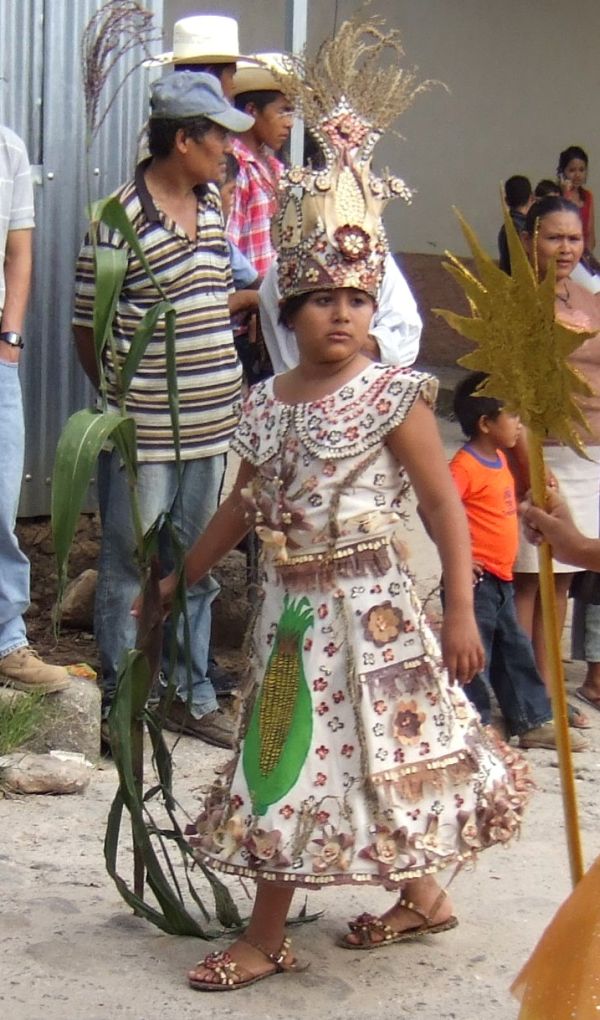
I have so many photos from Lempira Day that I've decided to post them over several days, in categories. The following photos show the fancy "Indian" dresses which are created by students in the public schools. As you will see, these dresses are made almost entirely from local, natural materials, including leather, burlap, seeds, feathers, beans, corn, etc. The dresses aren't attempts to recreate an authentic historical costume - instead, these dresses are flights of fancy. Some are simply decorative, others showcase a particular part of Honduran history or culture. Make sure to check out the elaborate headdresses - this year, it seemed to me, the headdresses were bigger than ever!

Many of the girls wearing the dresses also have sashes, which announce that they won a particular prize in the school India Bonita (beautiful Indian) competition, or won an award for best costume, etc. Click on the photos for a closer look at these - the details are amazing!

Tomorrow I plan to post pictures of the boy Indians!