Monday, February 12, 2018

One Down, Two to Go

If this were a television show, this is the part where a person with a wonderful speaking voice would say, “Previously, on the Sowers4Pastors blog…” That’s TV talk for, “Hey, let me refresh your memory, or just fill you in if you happened to miss an episode.” Well, this isn’t a television show, but previously on the Sowers4Pastors blog, we talked about the logistics of hosting three back-to-back teams. Now that you’re all caught up, we can move on to this week’s episode, er, post. It’s entitled One Down, Two To Go.

Team One, from Christ Church of Orlando, otherwise known as the Bridge-in-a-Week team, came down and did their thing (which you may have deduced involved building a bridge in a week). Russell and Allen thought this would be a good opportunity to explain the 4-way partnership that makes such a project possible.

The first partner is a church in the States. Not only does a church send a team to Honduras, they also raise a portion of the funding for the project. A participating church needs to be committed to providing finances, as well as labor. That commitment to finances helps purchase a significant amount of the necessary supplies. Then team members donate a week’s time and a lot of muscle toward building a bridge.

Partner number two is the local government, which helps determine where the bridge is most needed. Local government also helps pay for some of the building materials.

The local community serves as partner number three. As the people who will benefit from the completed bridge, the local community supplies most of the unskilled labor. Their tasks include removing rocks from the river, being involved with the team as the concrete is poured, and going up the mountain to get wood for the bridge deck.

Naturally, the fourth partner is Sowers4Pastors. They choose an appropriate bridge design for that location, calculate the construction budget, host the visiting team, transport them to and from the airport, get the supplies, coordinate the whole project, make sure there are enough volunteers, provide the skilled labor, and supervise the construction.

No one person pays for such a project. It relies on both North Americans and Hondurans. The Honduran government and a North American church join forces.
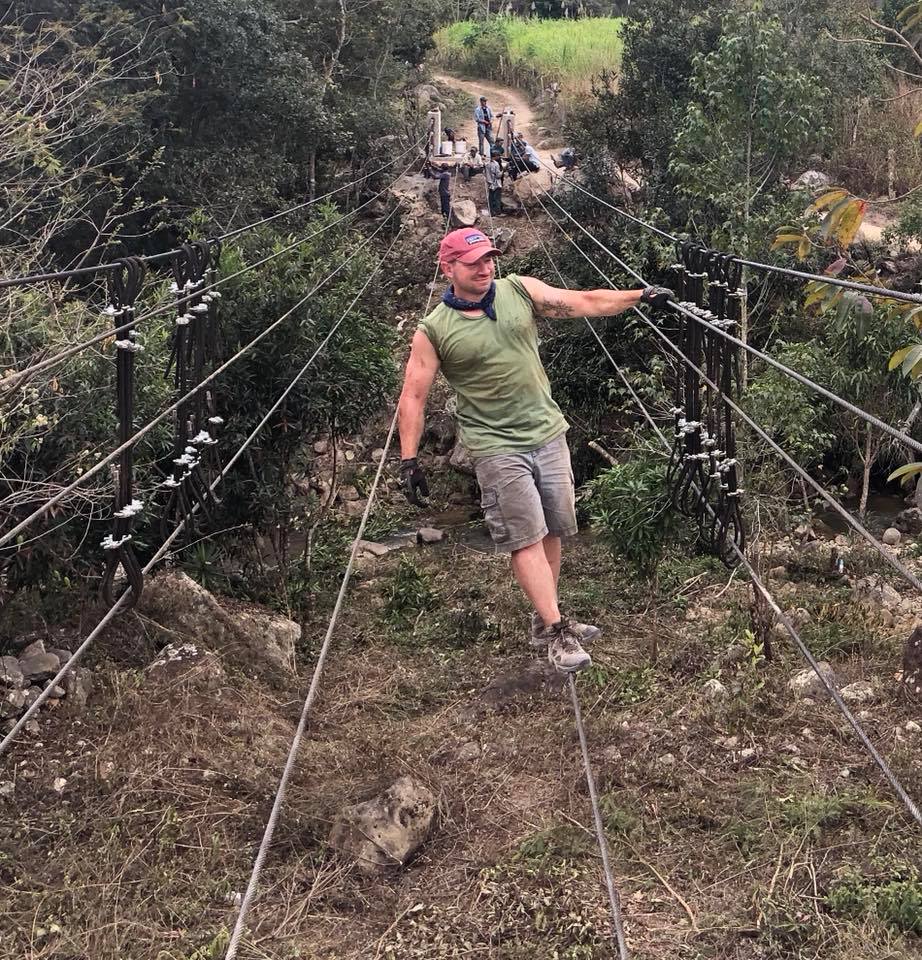

Team One arrived on a Saturday and the bridge was completed by Friday. Here’s what their week looked like:

Sunday--They showed up bright and early to dig holes. At that point, nothing had been done other than the prep work of gathering supplies, and the welding of internal, structural parts. They started pouring concrete on Sunday.

Monday--The second hole was completed on Monday and more concrete was poured.

Tuesday--This concluded the pouring of the concrete, as the handrails were put in place.

Wednesday--They started to string cables by walking the cable down through the river and tying them down on each side. The cables were tightened and made the correct length, so the deck of the bridge would be level.

Thursday & Friday--They built the deck of the bridge.

By Friday afternoon, they headed back to San Pedro Sula to spend the night before flying out on Saturday. Russell pointed out that by getting teams to San Pedro Sula the night prior to departure, they’ve never had a team miss a flight.


Now, if this were a television show, a voice would say, “Next week on the Sowers4Pastors blog…” But, like me, you’ll just have to tune in next week!

 - posted by Christi

Thursday, February 8, 2018

Losing at Monopoly, Winning at Ministry

What’s your strategy for playing Monopoly? Are you a purchaser of railroads? A hoarder of cash? A builder of houses? Generally speaking, my personal strategy is to just start giving my properties away so I can end the game and move on to other things that interest me more. After discussing the Sowers’ housing situation, I’m thinking that might be Allen and Trish’s strategy, too!

When Allen and Trish moved to their current property in 2009, they had big plans. At the time, they anticipated hosting visiting teams on the property. They had plans for building a team house with a couple of bunkrooms and big, communal bathrooms. Back when they lived on the island, there were no hotels, and they were accustomed to feeding and housing teams themselves. But Gracias happens to have some great, inexpensive hotel options, so that wasn't necessary. Still, a shell was built, and, while the bathroom was never put in, the four oldest Sowers offspring used that space as bedrooms, until they each grew up and moved out.

There were, of course, plans to build a family home. But money was available to build a warehouse, and not a house, so the warehouse was built and the family moved in, alongside the boxes and stored items. Sometimes ⅔ of the warehouse was used as personal space, and other times the boxes took up most of the space, until those donations were distributed.

As time passed, the ministry always took precedence over improved housing. Kids grew up, moved away, went to college, married, settled in the States, etc. Construction of a residence had been started, and was partly finished, but it had been designed for a family, not a pair of almost empty nesters.

A couple of years ago, Allen, Trish, and Ben were the only ones living on the property - still living in the warehouse. From a security perspective, that wasn’t good. Russell and Iris decided to remodel the team house and live in it. More people on the property was much better for security. It was also more convenient for Russell, as so much of his work was done in the warehouse or on the farm.

When Ben went to boarding school, Allen and Trish realized it didn’t make much sense for Russell’s family to live in a 900 sq ft space while they (Allen and Trish) completed an 1800 sq ft house. They made the decision that the big home would be Russell and Iris’s and that they would move into the small house. This also made sense because, with Ben away at boarding school, they made the decision to travel 3-6 months a year - and it seemed silly to have the bigger house sit empty so much of the time.

It’s now time for Allen and Trish to start paring down their personal possessions for the move to a much smaller home. This is the longest they’ve lived in any one house since they’ve been married. And, living in a warehouse meant they didn’t have to worry having space to store things . . . or about the size of their book collection!

When they moved from the island to Gracias, they took the contents of an actual lending library with them. That was not a problem in the warehouse because the bookshelves also served as walls. A few years ago, Trish donated many boxes of books to a local bilingual school. She recently sorted out and donated twenty-two more boxes of books to a different bilingual school. The joy on those kids’ faces, as they enjoy their new books, helps to compensate for the task of downsizing!

Construction on Russell and Iris’ new house has come to a temporary halt because it is currently storing the contents of two shipping containers. As soon as the backpack distribution and Gifts for Gracias are completed, the crew will get back to construction. Russell is hopeful they will all be in their new homes sometime in the fall!

And this explains why it is doubtful Allen or Trish have ever won a game of Monopoly, though you might say they’re winning at ministry.

 - posted by Christi

Monday, February 5, 2018

Dancing as Fast as They Can

During the 1920s and 30s, marathon dances were all the rage. Couples crowded onto a dance floor and danced (or at least remained upright and moving) in an effort to be the last ones standing. Hearing Russell detail Sowers4Pastors’ upcoming three weeks sort of reminded me of that. Instead of back-to-back dances, there will be back-to-back teams. 


There will be three back-to-back teams, as a matter of fact. As soon as Russell and Allen drop off one team at the airport, they will pick up the next team, and the metaphorical music will start all over again. Hosting three teams in such close succession means there will be no time to prepare for an incoming team between team visits, so this past week was all about getting their ducks in a row.


The first team is a bridge-in-a-week team, so last week, Russell and the crew welded the steel that holds cables to the concrete. Russell used some other words, too, but they sounded something like, “Blah, blah, blah, metal, blah, blah, blah, concrete, blah, blah, blah, reinforce, blah, stabilize,  blah, blah.” That is not a reflection of Russell’s ability to communicate, but is a reflection of my ability to tune out anything remotely technical. 

This project is being done in conjunction with the local community and the mayor’s office. The mayor’s office is helping to provide concrete, gravel, trucks, etc… Russell has been hard at work making sure all of the supplies are prepared. As he said, “We can’t keep running to the hardware store. It’s a bridge-in-a-week. We can’t afford delays.” 

The guys were also measuring footers so the team could start digging and pouring concrete as soon as they arrived. (Blah, blah…) Community members will assist by getting rocks out of the river and serving as unskilled labor. 

On Saturday, the bridge-in-a-week team will fly out and Team #2 will arrive from Ohio. They will be distributing backpacks and shoes for their sister church. As it turns out, the shoes have been such a hit that Sowers4Pastors needs to replenish their supply. Six hundred more pairs of shoes have been ordered, which the Ohio team will bring down in their luggage!


Team #2 will have the opportunity to hang out with the pastor of their sister church and look at his church plants. They will be able to better understand the church’s vision and how they can best help make his vision a reality.

Team #2 will fly out the next Saturday. Russell and Dillon will spend the night in San Pedro and Team #3 will fly in on Sunday from Maryland. Team #3 will also be distributing backpacks and shoes at their sister church. Because they partner with the largest sister church, the team will be visiting six schools in five days. Russell estimates they will distribute backpacks and find shoes to fit around sixty kids per day. They will fly out the following Saturday. 


The new pedestrian bridge will cross this river, shown here during dry season.
It gets much larger, and more dangerous to cross, during rainy season


Besides the preparation needed for the arrival of the teams, the village nearest to the Sowers' home asked for some help. They were in desperate need of a new roof for the kindergarten. Because of the leaky roof, kids couldn't go to school when it rained. Russell says it’s an extremely wet dry season this year, which is good for coffee, but not for kindergarteners! They made sure that the new roof was completed last week, since the Honduran school year starts soon!

Kelsea and Dillon arrived at a good time. Kelsea has been able to help out with things like organizing, posting to the blog, and paperwork. Dillon has been doing a lot of heavy lifting while loading and unloading backpacks. In a moment of sounding much older than his 28 years, Russell said, “We’re fortunate to have two, energetic young adults in their 20s to help out right now.”

- posted by Christi

Wednesday, January 31, 2018

The View from Kelsea

Friday morning, I piled into a van with eleven other people, a mixture of both Hondurans and North Americans, to revisit the Mercedes child sponsorship center. We had been there a few days prior to distribute backpacks and shoes to the children in the program, but we needed to return in order to collect letters from the children for their sponsors back in the States, as well as make sure the children who were absent at our last visit, received their backpacks and shoes.


When we arrived at the center, the children began to arrive as well. While a few began a game of soccer in the middle of the church floor, the others lined the walls of the building, standing quietly. A couple members of our group jumped right into the scene while the rest (myself included) stood off to the side to take it all in. As I stood there, I felt the weight of the language barrier. I so badly wanted to jump into their games, to talk to the children, to get to know them, to laugh with them, and to show them how loved they are. However, with my limited ability to speak and understand Spanish, I felt incapable.


As I watched, I saw an 8 year-old girl, sitting on the steps by herself. I walked over and sat next to her. I began to ask her how she was, her name, whether she had siblings there, whether she was excited to start school, etc.  She answered each question with a smile on her face and it wasn’t long before a boy of about the same age joined us. I began talking to him as well. One thing led to another and before long I was sitting in a circle of fifteen children playing catch, laughing with them learning their names.  As I looked around me, similar interactions were happening all throughout the church. I was struck by the way laughter, smiles, and a couple of Spanish words combined with the desire to connect, could build such a strong bridge between the lingual and cultural divide we were experiencing.

During our remaining time at the center, we played other games with the children, served them ice cream, took pictures with them, and exchanged lots of hugs! When it was time to leave, we said our goodbyes and piled back into the van.  I left Mercedes with a full heart, having made some new little friends, and reflecting on the importance of stepping outside of our perceived capabilities to simply show love to those we encounter.

 - posted by Kelsea

Monday, January 29, 2018

The Intern Has Landed

She’s there! She’s there! Kelsea, the young woman who will intern with Sowers4Pastors for a full year is there. (And, not to brag, but I got to talk to her.) When we spoke by phone, Kelsea had arrived in Honduras a whopping four days before. Naturally, she has spent that time sitting back and observing. Hahahaha. I’m kidding. This is Sowers4Pastors we’re talking about. Naturally, Kelsea hit the ground running and helping to distribute backpacks and shoes.

Kelsea, who hails from Washington State, was on two earlier short-term mission trips to Honduras, through Living Water. You might recall Dillon, the extended stay intern, also worked with Living Water. That is not a coincidence. Kelsea and Dillon met on her first trip to Honduras. It was Dillon and a friend of his who shared this exciting mission opportunity with Kelsea.

With four days in, Kelsea gave me her impressions thus far. So far, so great! She is enjoying learning about the different aspects of the Sowers4Pastors ministries. She has spent a lot of time with Allen and Russell, learning how the ministry impacts the communities of Western Honduras. She is excited to learn the various aspects of how to operate a ministry. She also said she loves how flexible it is. If by “flexible” she means how willing they are to do whatever is needed at any particular time, then she is in for a real treat!

When asked how she is able to spend a year in Honduras, Kelsea told me a bit about her background and dreams for the future. She graduated with an associates degree a few years back. She has been alternating between earning money in the U.S. doing childcare and office work and doing missions work abroad. This time, she only had two and a half months to fundraise for her year in Central America.

When her year in Honduras comes to a close, she would love to go home to work and raise money to do more work in Central or South America. She’s not exactly sure where that will be, but is open to any doors God may open. This is something she would love to do for the rest of her life. This has been the desire of her heart for the past four years or so. She has a desire to be self-sustaining, while churches and individuals support her ministry. That sounds more than a little familiar!

Kelsea studied Spanish for years. She said she knows enough to communicate with people, but she realizes how rusty she is. Fortunately, she is thrilled by how quickly her ability to understand native Spanish speakers is improving. Her brain is absorbing new vocabulary words and she’s dusting off some long forgotten verb tenses. Psst… Kelsea, if you ever need to know how to say, “The boy is under the airplane,” just let me know. I’m available for private Spanish lessons via Skype.

 - posted by Christi

Wednesday, January 24, 2018

Another Day, Another . . .

You know the old saying, “Another day, another gajillion backpacks to distribute and kids to fit with shoes!” What? You don’t know that old saying? Well, stick around, because it’s the sort of thing that comes up periodically on this blog. When I spoke to Russell this week, he was traveling to a Manna 4 Lempira center with Allen, the Hall family, Dillon, and Sowers4Pastors' newest intern, Kelsea.


Russell gave me a quick rundown of what his “social calendar” looks like this week. Really, the fun began last Friday when Russell and Dillon drove to San Pedro to pick up Kim Hall and family, who
arrived on Saturday. It was a gloriously uneventful trip because they encountered no road-blocking protests. (Russell would like to remind you that the international news has the job of showing the worst side of things. The dramatic protests you are seeing are not reflective of what is actually going on throughout most of the country at this time.)

Sunday: They visited the Tablon center, where they distributed 130 backpacks and pairs of shoes.

Monday: They headed to the Mercedes center, where they distributed a whopping 335 backpacks and pairs of shoes.

Tuesday: Tuesday found them at the Betania center, where they distributed 190 backpacks and pairs of shoes.

Wednesday: Wednesday brings us up to the day of our phone call. The group plans to visit the two daughter churches of the Tablon main church. That will mean visiting two completely separate locations. Russell anticipates distributing another 160 backpacks and pairs of shoes.

Thursday: On Thursday they will visit the new center opened in the fall, Quelacasque. This center has the distinction of being part sister church sponsored and part Manna 4 Lempira sponsored. One of the Manna 4 Lempira sponsors got her church in Kansas in on the fun and they are now a sister church. They will distribute backpacks and shoes to approximately 160 kids.

Friday and Saturday: As the week draws to a close, the group will revisit Mercedes and Betania, in order to see any children who were not there for the previous visits.

Saturday: On Saturday afternoon, Russell, Dillon, and Kelsea will drive the Hall family back to San Pedro to make their return flight on Sunday.


Children heading home with backpacks


Sunday is inauguration day in Honduras! Please be in prayer for Russell, Kelsea, Dillon’s safe travels on their drive home. Russell is feeling confident, as there are currently very few roadblocks happening.

 - posted by Christi

Sunday, January 21, 2018

The Crate Beyond

I always know it’s going to be a fun blog post when Trish warns me, “I hope it’s not too confusing!” It really piques a person’s interest! This time, the interest-piquing, possibly confusing topic had to do with packing boxes full of shoes.

“There’s a box packing frenzy going on,” Russell said during our latest phone call. And by “boxes” he means crates made out of ¾ inch plywood. So far, so good. That’s not too confusing. But, wait! Why are they building crates?

Allen, Russell, Dillon, and a few men from the crew are building crates because cardboard boxes simply don’t have what it takes to hold themselves together while carrying a bunch of shoes. They are constructing 52 crates in all. There will be 26 for boys and 26 for girls. Each crate will hold one size of shoes. The next crate’s contents will go up by a half size. Sizes will range from a children’s size 6 to an adult size 9.

Shoes being sorted, by size and gender, into the appropriate crates

When they take the shoes out for distribution, each child will be fitted for a new pair of shoes on the spot. Having the supplies well organized makes it possible to fit as many as 300 kids at one center in one day.


Is that clear? If not, please refer to the many pictures Trish instructed the menfolk to take in order to clarify any questions you may have.


As long as I had Russell on the phone, we chatted about the benefits of having an energetic, young, North American staying with them for three months. Dillon has been helping for a couple of weeks, and is being joined by Kelsea this weekend! They will be able to do things for which even the most willing Honduran would not be well-suited. Things like posting to Facebook and dealing with some of the paperwork and computer tasks. They will both be able to help out with some of the daily tasks facing Sowers4Pastors. And, as Russell pointed out, “There are a lot of tasks!”

Russell, Allen, and Trish are all excited there are four young adults currently confirmed to stay and work with them anywhere from a month to a year. They are also talking to other potential candidates.

Here are a few of the characteristics the ideal candidate should possess:


  • Must have a desire to serve God and others.
  • Young adult without the responsibilities that come along with having a family.
  • Enough energy to keep up with a family of Energizer Bunnies.
  • College age or older
  • The ability to stay for at least three months

If you fit those requirements, contact the Sowers to complete the application process.

 - posted by Christi

Friday, January 19, 2018

Extended Stay Missions

The Sowers are no strangers to one-week mission teams. They often host these teams throughout the year. In August 2016, one of those visiting team members was Dillon Cohee, a young man from Maryland, who participated in a bridge-in-a-week project. Now, Dillon has returned for what might be classified as an “extended stay” mission trip, as an intern with Sowers4Pastors.

Dillon (back left) during his bridge-in-a-week visit in 2016

Dillon also visited Honduras on a short mission trip to dig a well with Living Water, in 2015. That sparked interest for his trip with Sowers4Pastors. He said he's noticed a big difference between the two trips. He continued, “The Sowers’ trip was more real. They are so genuine. The Living Water trip was good, but there wasn’t that personal relationship where you were in direct contact with people involved in the ministry.”

When we spoke, Dillon was in his second week of what will be a three month stay with the Sowers family. Allen, Trish, and Russell thought it would be fun to have Dillon compare this trip with his previous trip. After all, this time he’s seeing what their ministry looks like from day-to-day, rather than when everything is laid out for a team.

Dillon described his duties as doing whatever is needed--from helping with teams, to working on the coffee farm, to sorting the contents of the infamous shipping containers. He said, “There’s a lot going on behind the scenes. I didn’t really understand about the shipments in the containers--how much stuff there is to sort through. I didn’t realize how many backpacks there are to organize. It’s something you don’t think about when you’re filling backpacks in the U.S. Here, you get boxes containing more than 5000 backpacks to organize before they can be distributed.”

Dillon (far right) works on a construction project  with Allen and Helder

How did Dillon manage to take an extended internship? The first thing in his favor is his age. Dillon is 23 years old. Since he doesn’t yet have a family to support, his schedule is more flexible. Also in his favor, is the fact he works for his cousin’s plumbing business. His cousin is very agreeable to Dillon taking time off for extended trips.

Why did Dillon decide to do this? He wanted something more than “working 40 hours per week, making money, and settling down.” He said, “The happiest I’ve been is when I’m far away from home and serving someone other than myself. I want to be serving a greater purpose rather than living the American dream.”

What does Dillon want others to know? “If anyone else is thinking about taking a mission trip. Pray about it, and if you get the go ahead, do it!”

What differences has Dillon noticed during this trip? Not as many as you might expect! He said, “When I was here building a bridge, it was go, go, go. They (the Sowers family) are workers! I knew that’s how it would be. I like that. You’re here. You might as well work hard.” The Sowers family agrees, wholeheartedly!

 - posted by Christi

Wednesday, January 10, 2018

A Third World To-do List

As far as To-Do lists go, Trish’s is just like most people’s, with the notable addition of some 3rd world issues. It is rare, after all, for us First Worlders to have something as exotic as evacuating a possum from our house. But other stuff is pretty mundane. Just like any mom, Trish needs to schedule occasional medical appointments for a family member. Of course, even her mundane tasks tend to have a 3rd world spin.
For the past year, Ben has been experiencing problems with his right knee. He thought it was due to a bad fall on concrete. While he was having some pain, it did not interfere with his regular activities, so he dealt with it. For a year. When a funny lump formed on the side of the knee, Trish and Allen said, “Enough is enough,” and made the decision to seek medical advice. Since that’s not as simple as finding a specialist on Yelp, Trish headed to a Facebook group for Americans living in Honduras and said she was looking for a good orthopedist. She received a response that a medical team from North America is currently in her neck of the woods for a month. The doctors are there on a rotating basis, but an orthopedic surgeon is there now!
Trish was able to schedule an appointment to have Ben seen. The orthopedist did the stuff orthopedists do (which I imagine involved some poking and prodding, in addition to X-rays). He diagnosed the lump as a benign tumor, having nothing to do with last year’s fall. It seems this type of benign tumor is something that can grow while a child is growing. If you’ve been paying attention to pictures, Ben has definitely been growing!
While it isn’t a major medical concern, it is best to have it removed. In Ben’s case, it has been catching a tendon or ligament (or whatever else makes a knee do the stuff knees are supposed to do) and causing the aforementioned pain. So, it’s time to wave bye-bye to Ben’s benign tumor! Surgery is expected to be today, but that is subject to change. Remember, there’s still third world stuff at play.
The prognosis is good. Ben should be on crutches for a couple of days and take it easy for a couple of weeks. He should be able to resume full activity in a month or two. The timing is also good because Ben is out of school right now.
Naturally, everyone is grateful this was not something more serious. This is something that can affect other body parts. As far as anyone knows, however, Ben doesn’t have any other weird lumps. Everyone is also grateful for a skilled surgeon who speaks English!
In other news…
It is Trish’s understanding that this morning’s earthquake did not cause any major damage. The earthquake was far offshore and that side of Honduras is sparsely inhabited swampland. The primary concern was of tsunamis, particularly since it is low lying land. Now, Trish is no seismologist (nor does she play one on TV), but to the best of her knowledge, the tsunami danger appears to have passed.
And, if you’ve been following the political climate in Honduras, the demonstrations seem to have petered out. The protesters appear to have lost their desire to cause a stir. What few protests there been recently have been small and peaceful. The Presidential inauguration is scheduled for January 27.

- posted by Christi

Thursday, January 4, 2018

Crazy, Crazy, Crazy, Busy, Busy, Busy

Occasionally, Allen offers a suggestion for a title of a blog post. Today, he suggested, “Crazy, Crazy, Crazy” or “Busy, Busy, Busy”. After thinking about it and rereading the notes from our conversation, it seemed prudent to smoosh the two suggestions together. Welcome to the Crazy, Crazy, Crazy, Busy, Busy, Busy blog post!

Members of the S4P crew, unloading
a spool of cable from the MD container
It’s a universal truth that sometimes things don’t go exactly according to plan. That universal truth is never more true than in the daily lives of the Sowers! The Sowers were anticipating hosting back-to-back teams, but the second team postponed its trip for personal reasons. The group plans on rescheduling for sometime later this year. While Allen, Russell, and Trish were disappointed by the postponement, it is not without its blessings.

You see, the Sowers are essentially booked with visiting teams through March. This unexpected postponement by one team has given the Sowers almost a full week of work days, and they intend to take full advantage of the gift of time. Here are a few of the things on their agenda:
  • This is the first time they have ever received two shipping containers at basically the same time and that amounts to a heap of work. Russell will be taking all of the contents of the shipping containers and organizing it.
  • They are entering what Russell calls the “super busy backpack distribution season”. This is the first time they have had eight sponsorship programs operating at the same time. This extra time will be used to organize a slew of backpacks filled with school supplies for the children in those programs. Russell says this gift of time means they “will not be running around like chickens with their heads cut off,” which is undoubtedly a good thing.
Using the Land Cruiser to ferry the contents
of the container from Gracias, up to our property.
The big container truck only goes as far as Gracias.
  • The new water tank will get some attention and Russell and the crew will be able to put the tubing together. (There was probably some more construction talk, but “tubing” was the word I understood. We’ll just go with that.)
  • The Sowers are also catching up on IRS paperwork--both their personal and ministry filings. The ministry filings alone take days of work to complete.
  • Russell and Allen will have more time to prepare for future team visits. Kim Hall’s team arrives in two weeks and two construction teams are scheduled to arrive soon. That means extra preparation to make sure all of the supplies are lined up, etc...
  • Part of Russell’s attention will go to preparing for work during the dry season on the coffee farm.
  • Trish is hoping that, with this extra bit of time, the eviction of the opossum from their home/warehouse can be moved up on the schedule a bit, too.

So, while the postponement of a team visit was not welcome news, Sowers4Pastors is making a big ol’ pitcher of lemonade from lemons. Even Allen admitted they were almost overloaded with commitments.

Unloading the big orange container from Maryland!
In other news… The political protests have calmed down, which is what allowed for the delivery of the second shipping container. The ministry did take a financial hit by having to pay a fee for having the containers stored for extra time. In the grand scheme of things, that is peanuts! The valuable supplies on the containers were worth far more than the unanticipated fees.

Allen would like to remind people that the news can be very sensationalized. The job of news sources is to hone in on the worst things that have happened. Overall, Allen feels the political climate is much more calm than it was immediately following the election. That is great news during this crazy, crazy, crazy, busy, busy, busy season!

 - posted by Christi

Thursday, December 28, 2017

The Pilot Episode of Missionary Mayhem

If you know her personally, you know Trish Sowers is most emphatically NOT a drama queen. That’s why it’s more than a little ironic that this very laid back woman is generally surrounded by enough mayhem to make Lucy Ricardo feel right at home. Since Russell and Allen were out and about during the time of our weekly phone call, I had a chance to catch up with Lucy, er, Trish. Think of this as more of a script for a pilot episode of some sitcom about Honduran missionaries than a blog post.

Setting

The political situation in Honduras appears to be semi resolved. It looks as if the winner of the election is probably going to actually be the president. The other side will probably continue to protest, but they have said they will be non-violent protests. And both sides made a point of saying they will keep things calm over the holidays.

Because of that, the Sowers4Pastors shipping container, which was being held at port until it was safe to transport was finally able to make it all the way home on December 26. But, due to the delay, the container was scheduled to arrive the same day as a short-term missions team. Let the zany antics commence!

Allen drove to San Pedro on Christmas night so he would be able to meet Michelle Spanos and a team of college students on the 26th. The students were arriving from various parts of the U.S., due to the holidays. There was a plan that Russell would drive to San Pedro and transport the earlier arriving team members back to Gracias, while Allen stayed to meet the late comers.

Meanwhile…

Russell got word that the container would be arriving very early on Monday morning, so he changed the plans, having Allen to collect the earliest arriving team members, while he stayed in Gracias to unload the container and then headed to the city to collect the later arriving team members. After waiting a few hours for the container to arrive, however, Russell got word that the container wouldn’t be pulling into Gracias until noon! So, Russell hopped into the new-to-them, big, white van to head to the airport to pick up the visiting team. He left the crew in charge of meeting and unloading the container. Russell was less than a half hour out when he saw the container heading the other way. He waved to it as it passed, knowing the crew was about to get down to the work.

The view out the windshield of the van, as the
container truck arrives from the other direction
At some point during Russell’s trip to San Pedro, the driveshaft on the aforementioned new-to-them, big, white van broke. If you recall, this van was purchased especially for use with visiting teams. This was its maiden voyage, so to speak. Russell was able to rent a vehicle to transport the team, but because it was the last minute he was only able to rent a pickup truck for a one day rental.

The visiting team members were bundled and put in the back of the pickup along with their luggage for a chilly, drizzly ride to their lodging. Keep in mind, their hotel is a few hours away from the airport! Trish referred to that as their “mission trip adventure number one!”

The following day, while Allen took the team out for their activities in the Gracias area, Russell was making another trip to San Pedro, to return the pickup truck and collect the newly repaired van.

Scene at Home

Because of the overcast, drizzly weather, not much power is coming in at the ol’ homestead. The generator has a problem in its breakers and every so often it stops charging the batteries. It runs for about five minutes and then someone has to go out to do whatever it is you do to make it start running again. Trish and Ben have been taking turns getting it up and going, so that the buildings have lights through the night. Laundry is piling up because of the lack of power, too,  but even Trish is not quite ready to go out and beat the clothes on a rock. She’ll wait until she can use her washing machine, thankyouverymuch.


Random possum photo 

Oh, and there’s still a possum at large in Allen and Trish’s house. It mostly keeps to itself, but you might run into it if you have to get up in the middle of the night. Since the family is busy with back-to-back teams, Project Possum Removal has been penciled in for about two weeks from now!

 - posted by Christi

Thursday, December 21, 2017

The Goal of Working Yourself Out of a Job


During our most recent phone call, Russell jokingly threw out a phrase I’ve heard (and used) many times. He said, “When you get right down to it, our goal as missionaries is to work ourselves out of a job.” Oh, okay, I hadn’t heard the sentiment applied to missionaries before, but I’ve heard it used for parenting, homeschooling, and the corporate world. Hearing Russell say that started me pondering what the phrase really means. In this case, Russell was applying it to some exciting developments concerning Pastors’ Training School. It didn’t take long to decide pondering is too much work. So, I tossed aside the pondering and tried Googling instead. In a nutshell, it seems “working yourself out of a job” is about investing in others, sharing your knowledge and unlocking potential. (Thanks, Google!)

As you probably already know, there are four separate ministries working together to make Pastors’ Training School happen. What you probably don’t know is that a sort of Pastors’ Training School plant has taken root in the mountains of Western Honduras. (Think of it as a church plant only in Pastors’ Training School form.)

Each year at Pastors’ Training School, the top 5 students who return to complete the next year of classes also become mentors to the class level below them. These students help with the teaching. They also go out into the villages to meet with the students on their home turf, and help them with their studies.

Sowers4Pastors has worked with Mercedes Church for over ten years. For the past eight or nine years, the church has also been the site of a Sowers4Pastors feeding center. Allen has spent a full decade investing in others at that church. The senior pastor at Mercedes is an older gentleman who attended Pastors’ Training School in about 2008. He is also a supervisor for the denomination and has oversight of nineteen different churches. Not surprisingly, that pastor’s son and son-in-law are current “star students” serving as mentors for Pastors’ Training School. But they’ve taken the mentoring thing a step further!

These guys decided to start their own Pastors’ Training School on a separate campus! They opened it up to others, utilizing the same materials, methods, and quality lesson plans used at the original training school. How is it going? Well, they just graduated their first class of nineteen students! The two missionaries who serve as teachers for the original school even signed the diplomas for the Pastors’ Training School plant. Clay Powell (Seeds of Salvation) paid some visits to the school to offer support, but the two indigenous mentors did all of the work. When you get down to it, it’s an almost 100% Honduran endeavor!

The school can thank First Baptist Church of Kingsland, Georgia, and their pastor, Brian Parker, for purchasing a study Bible and a Bible dictionary for each student. The students utilized the books during classes. At the end of the year, they were able to take home the books, which cost about $40 for the Bible and $35 for the dictionary. Because this school operates in their own village, they do not have to worry about supplying food and shelter for the students.

While the original Pastors’ Training School is still needed in Honduras, it’s wonderful to see how the missionaries’ investment in others is unlocking potential!

 - posted by Christi

Thursday, December 14, 2017

Little House in Honduras

Welcome to this week's episode of Little House in Honduras. Yes, sometimes talking to Trish can seem a little like having a phone call with Laura Ingalls Wilder. Seriously. It's like having the phone ring and suddenly being transported to a time when people weren't living in climate controlled environments and their biggest water concern wasn't whether to buy bottled or use a Brita filter.
People in Honduras are at the mercy of the seasons to a much larger degree than most modern North Americans can imagine. Oh, sure, we can have scorching summers and freezing winters, but that’s why God created central heat and air. Right? Honduran buildings tend to be open air. As Trish said, “When it’s cold, we’re cold. When it’s hot, we’re hot.” The same concept applies to water. When it’s the rainy season, water is plentiful. When it’s the dry season, having an adequate water supply is a big honkin’ deal! Water shortages are a reality during dry seasons. FYI, a dry season typically runs from fall to late spring.


Existing (round) water tank,
and larger tank (under construction) in the background

The Sowers built a water system when they first moved to their property. It’s a private system, which involves underground pipes and a 6000 gallon water tank. But that system was set up for one family. Now, the property is home to two families and a coffee farm. That 6000 gallons of water doesn’t go very far. That’s why the Little House in Honduras family is in the process of building a water system, which will more adequately meet their current needs.
Wall panels going up, to pour the concrete walls of
the larger tank


Even though the Honduran climate is well suited to growing coffee, the coffee farm does require a substantial amount of water. It does not require irrigation, but the fertilizer, fungicides, pesticides, etc… all come in a powder form. They are mixed with water and sprayed onto the plants. One application of one product requires 2000 gallons of water! It’s like a pioneer math problem: If Pa and Ma Sowers have 6000 gallons of water and Russell and his crew use 2000 gallons of water spraying coffee plants, how long will it be before it’s time to break out a divining rod? (Okay. They don’t have a divining rod. But they have had to pay the firemen to fill the water tank.)


Fortunately, this new system involves an additional, larger tank, which holds 60,000 gallons of water! Some dimensions were tossed around, but all you really need to know is that it’s roughly the size of a three car garage! A new pipe system is also in the plans, but first things first.


General construction details


Allen wants to stress there are some benefits to the dry season. It’s the time when most church and bridge construction takes place. Most buildings in Western Honduras are made out of homemade adobe bricks. When the bricks get wet, they are about as durable as bricks made from Play-doh. (And they probably don’t even taste as good!) The adobe sort of melts with the rain. By the time the rains come, the completed buildings will be protected by roofs.


It’s enough to make the Ingalls family and the folks in Walnut Grove proud!

- posted by Christi


- pictures by Ben Sowers

Friday, December 8, 2017

Come Along on a Virtual Visit to Our Most Recent Bridge Project!

You've heard it mentioned in previous blog posts . . . now you can see it! We've been working on replacing the old, worn-out pedestrian bridge at Las Crucitas with a new bridge that can handle vehicles up to pickup trucks! In this video you can see the two bridges side-by-side! 


This bridge is a result of cooperation between the local government, volunteers from the communities that are served by this bridge, and fundraising help from Eric Linden in Jacksonville, Florida . . . plus Russell and Sowers4Pastor' trained, bridge-building crew!

We have a small - but good - problem with our bridge construction ministry: we've installed new bridges in most of the sites needing them in the vicinity of Gracias. When teams want to help build bridges in the future, they may need to rough it out in a more remote area, possibly sleeping in a church in a village that doesn't have any hotels or restaurants. (Our usual teams get a bit spoiled staying  and eating at the lovely Guancascos Hotel in Gracias). So, who's up for a remote bridge construction project? Hmmmm?

- posted by Trish

Monday, December 4, 2017

One Day's Trip to the Airport . . . Through the Roadblocks

We have an exciting story to tell you!

First things first – we want to thank everyone who is involved in praying, as part of our large, informal but effective prayer support team! You guys know how living in Honduras adds certain risks to our lives – bad roads (extreme curves, minimal traffic laws, lack of guard rails, gigantic potholes, . . . ), reduced quality and availability of medical care, increased exposure to diseases, etc. We do our best to take certain precautions – like keeping our vehicles well maintained, and avoiding more dangerous parts of the large cities, especially at night (just like you would likely do in the U.S.).

With all this in mind, we know that God has called us to live here, and sometimes living and working here requires us to take certain greater risks. Many of the things we ourselves do day-to-day involve risks we would never expose teams to – like Trish (a woman alone) driving on back roads, or Allen eating unsafely-prepared foods in people’s homes.

In spite of the unsettled situation in Honduras, Friday morning Allen and Russell found it necessary to make a trip to San Pedro Sula and back. We had a guest who needed to get to the airport. Dennis has experience traveling in third world countries and he was in-the-know about the risks involved in trying to get to the airport on that day. We also had other guests, two men, who were already in country and arriving in Gracias, from Tegucigalpa, that evening.

It was slow going. Starting out, they saw multiple areas where protests had previously taken place, and had already been broken up, and the roads were clear.

Russell took this short video, during their trip.

At one point, they came to where a protest was in progress, and no traffic was getting through, except for motorcycles and pedestrians. Right then, the military police arrived, to re-open the road. Russell walked up to the front of the protest, to see and hear how things were working out. He heard the police say that they had orders to re-open the road, and they didn’t want to have to use force. The protest leaders said that they didn’t want to stop protesting. They negotiated an agreement where the protesters stayed on only one side of the road (the road is one lane in each direction), and the other side would remain open, with vehicles going north and south taking turns using that lane. It was handled peacefully, and the men were able to move forward along the road again.

Eventually, outside of San Pedro Sula (around 15 miles from the city), they got stopped in a roadblock that just didn't budge. After checking the situation to see if the blockage would be cleared, Allen and Dennis decided to walk through the roadblock, and pay for rides on the other side.

Once they reached open road again, they alternated between hiring taxis, walking, and hitching rides. They saw lots of action, but were personally unharmed throughout the trip. In one especially odd event, they had negotiated a price with the driver of a small, open-air taxi, to take them out from a roadblock. When the driver got them to their destination at the back of the protest area, and they were preparing to pay him, a crowd of protesters demanded to know, from the driver, how much he was charging his passengers. When he told them an amount (about half of what had actually been agreed upon), the crowd threatened to beat the driver - because he was price gouging! Fortunately, there was an off-duty policeman in the taxi with them, and he managed to calm the protesters!

Eventually, Allen and Dennis made it safely to a hotel near the airport. Once he knew they were safely settled for the night, Russell turned around and started driving back to Gracias.

Russell had a long trip, dodging protests and roadblocks at night. At one point, he and a caravan of other vehicles were led along back roads, for an hour, by knowledgeable locals on motorcycles, to get around a large roadblock (for a fee). Russell actually arrived home earlier than we'd anticipated, as the roads were basically clear for the second half of his trip.

Our guests coming from Tegucigalpa were having their own troubles. Traveling with Honduran friends in a pickup truck, they were caught up in traffic at several roadblocks, eventually arriving at their hotel in Gracias in the wee hours of the morning.

Saturday morning, when things were quieter, Allen headed off from the hotel, to make his way back to Gracias. (The guest had to reschedule his flight, as his previously scheduled flight on Friday was cancelled.)

He was able to get to the bus terminal in San Pedro, but it was all closed up, and looters were trying to gain entry. Since there were no buses available, Allen hitched a ride in the back of a pickup truck. (Hitchhiking - with a small amount paid to the driver - is a surprisingly safe and common means of transport in Honduras.)

Six hours and several different pickup trucks later, and absolutely covered in black soot from the smoke of the burning tires at all the protest sites, Allen made it back as far as Las Flores, a few miles outside of Gracias (normally a trip of about 3 – 4 hours). Russell and the guests picked him up there . . . and Allen went immediately to work, showing the visitors the work of the ministry in that area.

And that, my friends, is the short version of the story! LOL

Praise the Lord, throughout all of this none of these folks - Allen, Russell, or the guests - were ever threated with any harm. These are remarkable times – not at all the norm for Honduras - but we won't be afraid to continue the work God has given us to do here!

 - posted by Trish (for a change)